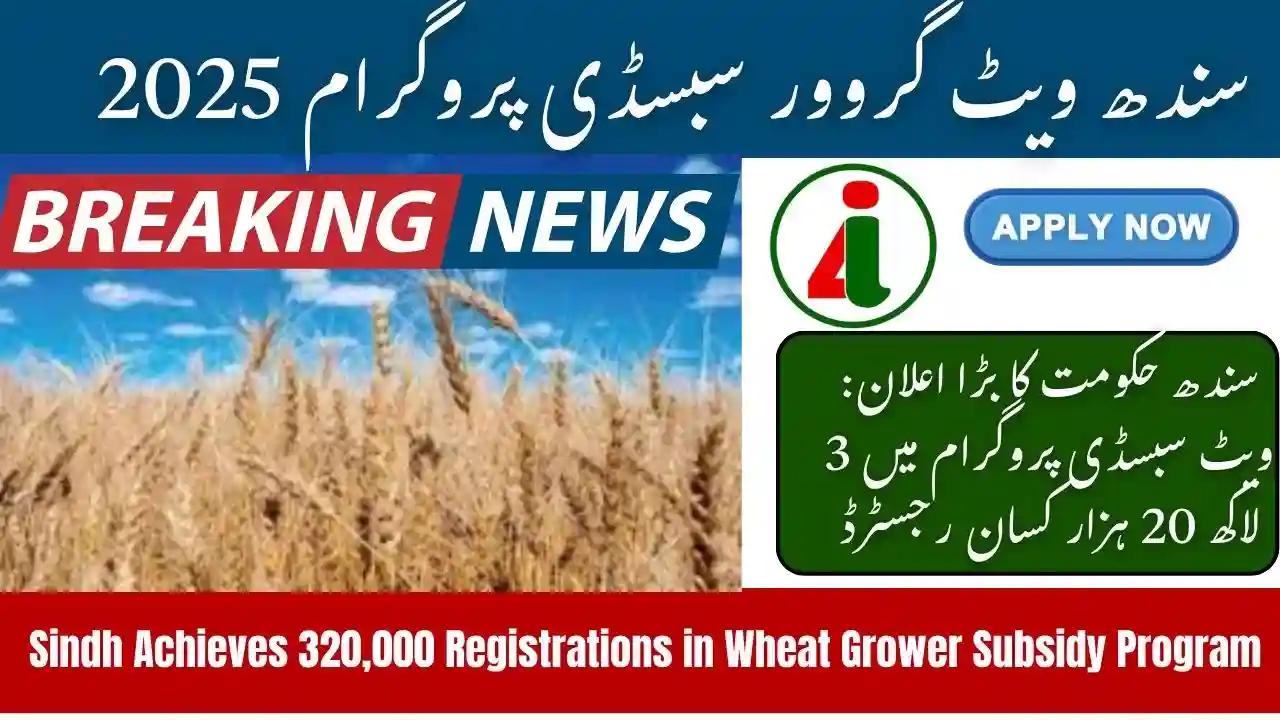
The Sindh Achieves 320000 Registrations in Wheat Grower Subsidy Program has officially announced a major breakthrough in its agricultural development efforts as registrations under the Sindh Wheat Grower Subsidy Program have crossed 320,000 farmers. This historic milestone highlights the province’s commitment to strengthening food security, improving wheat production, and supporting small and medium-scale farmers through transparent and targeted subsidies.
The Sindh Wheat Grower Subsidy Program 2025 is one of the largest farmer-support initiatives in the province, designed to lower cultivation costs, increase per-acre yield, and empower growers with digital and financial assistance.
Overview – What Is the Sindh Wheat Grower Subsidy Program 2025?
The Sindh Wheat Grower Subsidy Program is a provincial initiative launched to support farmers during the crucial wheat cultivation season. The program provides financial subsidies, digital registration, transparent verification, and targeted incentives to eligible farmers.
Primary Objectives
- Reduce wheat cultivation expenses for small and medium farmers
- Ensure timely sowing and increase wheat production
- Promote digital agriculture and transparent farmer identification
- Strengthen food security through improved output
- Help farmers access government support without middlemen
Crossing 320,000 registrations shows massive farmer participation and trust in the initiative.
Sindh Achieves 320,000 Registrations – What This Means for Farmers
Reaching 320,000+ registered farmers confirms the program’s massive reach across the province. This number includes farmers from:
- Karachi
- Hyderabad
- Sukkur
- Larkana
- Mirpurkhas
- Shaheed Benazirabad
- Rural districts
With such a large number of farmers now verified, the subsidy distribution will be fast, transparent, and targeted.
Key Highlights
- Over 320,000 farmers registered across Sindh
- Digital registration enabled through agriculture offices & mobile camps
- Verified farmers are eligible for wheat cultivation subsidies
- Priority given to small landholders (5–16 acres)
- Program aims to cover all major wheat-growing districts
Why the Program Matters – Importance of Supporting 320,000 Farmers
Sindh contributes significantly to Pakistan’s wheat supply. However, farmers face challenges like:
- High input costs
- Rising seed & fertilizer prices
- Expensive diesel for tube wells
- Climate change impacts (heat waves, floods)
- Lack of modern machinery
This subsidy aims to bridge the gap, making wheat cultivation more profitable and sustainable.
Expected Outcomes
- Increased wheat acreage
- Higher per-acre yield
- Lower production costs
- Improved farmer income
- Reduced dependency on middlemen
- Better quality wheat supply to markets
Read Also: Capital Smart Motors Electric Vehicles Launch in Pakistan – Complete Price & Features List
Subsidy Details – What Benefits Registered Farmers Will Receive
Once registered and verified, farmers will receive various forms of support. These may include:
1. Subsidy on Certified Wheat Seed
A major portion of the subsidy is focused on providing discounted certified seed to ensure better crop yield.
Expected Benefit:
Farmers get high-quality, disease-resistant seed at lower prices.
2. Subsidy on Fertilizers
Registered farmers may receive support on fertilizers such as:
- Urea
- DAP
- Potash
- Micronutrients
Expected Benefit:
Reduction in cultivation cost by 15–30%.
3. Support for Land Preparation
This may include:
- Ploughing subsidy
- Laser land leveling
- Land preparation support
4. Digital Farmer ID & Verification
Every registered farmer receives a digital identity to prevent fraud and ensure fair distribution.
5. Transparency Through Digital Mapping
Agriculture fields are digitally mapped to calculate actual acreage and ensure targeted subsidy allocation.
Eligibility Criteria – Who Can Register?
To qualify for the subsidy, farmers must meet the following conditions:
✔ Must be a resident of Sindh
✔ Own or lease agricultural land
✔ Active wheat cultivator
✔ Land record must be verified from Board of Revenue (BOR)
✔ Valid CNIC required
Priority is given to:
- Small farmers (up to 16 acres)
- Flood-affected farmers
- Women farmers
- Tenant farmers (after verification)
Required Documents for Registration
Farmers need the following documents to complete their registration:
- CNIC
- Mobile number
- Land ownership papers
- Tenancy documents (if applicable)
- Bank account details
- Recent photograph
- Agriculture passbook (optional)
Read Also: Sindh Government Launches 500 Electric Buses Initiative for Cleaner Public Transport
Registration Process – How Farmers Reached 320,000+ Enrollment
The Government of Sindh used multiple digital and physical channels to ensure maximum reach:
1. Visit Agriculture Department Office
Farmers could register by submitting documents to their nearest agriculture office.
2. Mobile Registration Camps
Special camps were set up in:
- Villages
- Town centers
- Agriculture markets
- Union councils
3. Digital Verification
Land details were verified using:
- Sindh Board of Revenue
- Digital land records
- Satellite mapping
4. SMS Confirmation
Once verified, farmers received an SMS confirming their registration.
This multi-step approach helped the program achieve 320,000 successful registrations.
District-Wise Impact – Where Registrations Are Highest
While all districts participated, major wheat zones showed the highest turnout:
| District | Registrations |
|---|---|
| Larkana | High |
| Sukkur | High |
| Ghotki | High |
| Khairpur | High |
| Sanghar | Medium |
| Mirpurkhas | Medium |
| Badin | Medium |
| Thatta | Moderate |
| Hyderabad | Moderate |
How Subsidy Will Be Distributed
The subsidy distribution process will follow these steps:
Step 1 – Registration
Farmer completes registration at an official center.
Step 2 – Verification
Land and farmer identity verified digitally.
Step 3 – Token/Slip Issuance
Verified farmers receive a subsidy token.
Step 4 – Redemption
Farmers can claim:
- Seed subsidy
- Fertilizer subsidy
- Financial support
Step 5 – Monitoring
Agriculture teams ensure transparency and prevent misuse.
Program Benefits – How 320,000 Farmers Will Gain
1. Lower Cost of Cultivation
Seed and fertilizer subsidies significantly reduce input costs.
2. Higher Crop Yield
Certified seed improves productivity by 20–40%.
3. Transparent Support
Digital verification removes intermediaries and corruption.
4. Climate Resilience
Modern seed varieties are drought and heat resistant.
5. Food Security
Higher wheat production supports provincial supplies.
Government’s Future Plans
The Sindh government plans to:
- Expand registrations beyond 350,000
- Introduce smart subsidy for machinery
- Launch crop insurance for wheat growers
- Provide climate-resilient seed varieties
- Integrate mobile apps for farmer services
Frequently Asked Questions (FAQs)
1. What is the Sindh Wheat Grower Subsidy Program?
It is a government initiative to reduce wheat cultivation costs through seed, fertilizer, and financial subsidies.
2. How many farmers have registered so far?
Over 320,000 farmers have successfully registered across Sindh.
3. Who is eligible for the subsidy?
Any wheat cultivator owning or leasing land in Sindh with a valid CNIC.
4. What documents are required?
CNIC, land papers, mobile number, tenant documents (if any), and bank details.
5. Is registration still open?
Yes, subject to district announcements. New farmers may still join.
6. What kind of subsidy will farmers receive?
Discounts on certified seed, fertilizers, and possible financial support.
7. How will farmers know they are approved?
An SMS confirmation will be sent after verification.
8. Can tenant farmers register?
Yes, after verification from landowners and BOR records.
9. Is the subsidy for all wheat farmers?
Priority is for small farmers, but all verified growers may benefit.
10. How can farmers check their status?
Status can be checked through SMS or by visiting the agriculture office.
Conclusion
The achievement of Sindh Achieves 320000 Registrations in Wheat Grower Subsidy Program marks a major agricultural milestone for the province. Through transparent processes, digital verification, and targeted support, the program is expected to reduce cultivation costs, boost wheat production, and empower farmers across Sindh.