The Government of Pakistan has officially announced a fresh increase in Petrol and High-Speed Diesel (HSD) prices under the latest Oil and Gas Regulatory Authority (OGRA) pricing review. According to the official Ministry of Energy (Petroleum Division) press release issued on 23 July 2026, the revised ex-depot prices of petroleum products will come into effect from 24 July 2026.
The latest fuel price revision follows the Government’s revised petroleum pricing mechanism and reflects changes in international oil prices, exchange rate movements, freight costs, and other pricing factors. The increase will directly affect motorists, transport companies, farmers, industries, and households across Pakistan.
Every fortnight, the Federal Government reviews petroleum prices after receiving recommendations from OGRA. Since fuel prices influence transportation, logistics, agriculture, manufacturing, and consumer goods, these announcements are among the most important economic updates in Pakistan.
This article provides complete details of the latest OGRA petrol price notification, revised fuel rates, official government announcement, reasons for the increase, expected economic impact, and what consumers should expect in the coming weeks.
Government Announces Latest Petrol & Diesel Prices
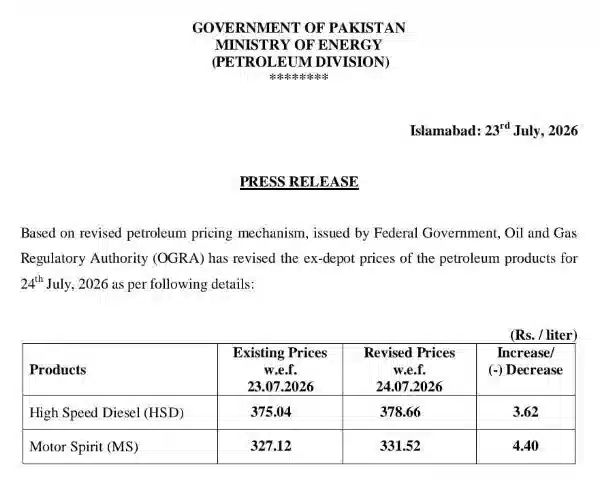
The Ministry of Energy (Petroleum Division) officially confirmed that the revised petroleum prices will be effective from 24 July 2026.
According to the notification, both Motor Spirit (Petrol) and High-Speed Diesel (HSD) have become more expensive.
The latest revised prices are:
| Petroleum Product | Previous Price | Revised Price | Increase |
|---|---|---|---|
| Motor Spirit (Petrol) | Rs. 327.12/Litre | Rs. 331.52/Litre | Rs. 4.40 |
| High-Speed Diesel (HSD) | Rs. 375.04/Litre | Rs. 378.66/Litre | Rs. 3.62 |
These revised prices are applicable throughout Pakistan from 24 July 2026.
Official Government Notification
The official press release issued by the Government states:
Government of Pakistan
Ministry of Energy (Petroleum Division)
Islamabad – 23 July 2026Based on the revised petroleum pricing mechanism issued by the Federal Government, the Oil and Gas Regulatory Authority (OGRA) has revised the ex-depot prices of petroleum products effective from 24 July 2026.
High-Speed Diesel (HSD)
Existing Price: Rs. 375.04
Revised Price: Rs. 378.66
Increase: Rs. 3.62
Motor Spirit (Petrol)
Existing Price: Rs. 327.12
Revised Price: Rs. 331.52
Increase: Rs. 4.40
The notification confirms that all fuel stations and Oil Marketing Companies across Pakistan will implement the revised prices from 24 July 2026.
Latest Petrol Price in Pakistan
The latest Petrol Price in Pakistan has increased by Rs. 4.40 per litre.
The previous petrol price was Rs. 327.12 per litre.
After the latest revision, consumers will now pay Rs. 331.52 per litre.
The increase affects:
- Private car owners
- Motorcycle riders
- Taxi drivers
- Ride-hailing services
- Commercial transport operators
Petrol remains the primary fuel used by millions of vehicles across Pakistan, making this revision significant for everyday commuters.
Latest Diesel Price in Pakistan
The latest High-Speed Diesel (HSD) price has also increased.
The previous diesel rate was Rs. 375.04 per litre.
The revised diesel price is now Rs. 378.66 per litre.
This represents an increase of Rs. 3.62 per litre.
Diesel is widely used by:
- Heavy transport vehicles
- Buses
- Trucks
- Agricultural machinery
- Construction equipment
- Industrial generators
Because diesel powers Pakistan’s logistics and agricultural sectors, even a small increase can have a widespread economic impact.
Why Have Petrol & Diesel Prices Increased?
The Government revises petroleum prices after considering recommendations from OGRA.
Several factors determine domestic fuel prices, including:
- International crude oil prices
- Exchange rate fluctuations
- Import premiums
- Ocean freight charges
- Petroleum Levy
- Distribution margins
- Oil Marketing Company (OMC) margins
- Government taxation policies
Pakistan imports a large quantity of crude oil and refined petroleum products. Therefore, any increase in global oil prices or weakening of the Pakistani Rupee usually leads to higher domestic fuel prices.
Understanding Pakistan’s Petroleum Pricing Mechanism
Pakistan follows a regulated pricing mechanism under which petroleum prices are reviewed every fifteen days.
The process generally includes:
- Monitoring international crude oil prices.
- Reviewing import costs.
- Calculating freight charges.
- Evaluating currency exchange rates.
- Assessing taxes and petroleum levy.
- Preparing recommendations by OGRA.
- Final approval by the Federal Government.
After approval, the Ministry of Energy (Petroleum Division) issues an official notification announcing the revised prices.
Role of OGRA in Fuel Price Determination
The Oil and Gas Regulatory Authority (OGRA) is Pakistan’s independent regulatory authority responsible for overseeing the country’s oil and gas sector.
Its responsibilities include:
- Regulating petroleum companies.
- Monitoring fuel supply.
- Ensuring fair competition.
- Licensing Oil Marketing Companies.
- Reviewing petroleum pricing data.
- Recommending revised fuel prices.
While OGRA calculates recommended prices, the Federal Government retains the authority to approve and announce final petroleum rates.
Impact on Transportation Sector
Transportation is expected to experience one of the biggest impacts of the latest fuel price increase.
Higher petrol and diesel prices usually result in:
- Increased public transport fares.
- Higher intercity bus ticket prices.
- Increased freight charges.
- Higher ride-hailing service costs.
- More expensive courier and delivery services.
Businesses that depend heavily on transportation may also pass additional costs on to consumers.
Impact on Agriculture
Pakistan’s agriculture sector relies extensively on High-Speed Diesel.
Farmers use diesel-powered equipment for:
- Tractors.
- Tube wells.
- Harvesters.
- Water pumps.
- Land preparation.
- Crop harvesting.
The increase in diesel prices may raise production costs and affect farming expenses across the country.
Impact on Inflation
Fuel prices influence nearly every sector of Pakistan’s economy.
As transportation costs rise, businesses often increase prices of goods and services.
Consumers may witness higher prices for:
- Food items
- Vegetables
- Fruits
- Milk
- Construction materials
- Household goods
- Industrial products
Consequently, fuel price revisions often contribute to overall inflation.
Impact on Businesses Pakistan Petrol Price News – Check the Latest OGRA Petrol & Diesel Rates
Businesses involved in logistics, transportation, manufacturing, and distribution are expected to face higher operational expenses.
Industries operating large fleets of vehicles or diesel-powered machinery will experience increased fuel costs, potentially affecting production and service charges.
How Often Does Pakistan Revise Fuel Prices?
The Federal Government generally reviews petroleum prices every 15 days.
Each review considers:
- Global crude oil prices.
- International market trends.
- Exchange rate movements.
- Petroleum Levy.
- Freight charges.
- Import costs.
- Recommendations submitted by OGRA.
The revised prices become effective immediately after the official notification is issued.
Public Response to the Latest Fuel Price Increase
Fuel price announcements are closely monitored across Pakistan because they directly affect household budgets.
Many consumers are concerned that higher petrol and diesel prices will increase transportation costs and eventually lead to higher prices of everyday necessities.
Business associations, transport companies, and farmers also closely watch petroleum price revisions because fuel represents one of their largest operating expenses.
Tips to Save Fuel
Although fuel prices are determined by government policy and international markets, consumers can reduce fuel expenses by:
- Maintaining proper tyre pressure.
- Driving at steady speeds.
- Avoiding unnecessary trips.
- Keeping vehicles properly serviced.
- Using public transportation where possible.
- Planning travel efficiently.
- Sharing rides with family or colleagues.
These measures can improve fuel efficiency and help reduce monthly fuel costs.
Future Outlook
Future Petrol and Diesel prices in Pakistan will continue to depend on:
- International crude oil prices
- Exchange rate stability
- Global shipping costs
- Government taxation
- Petroleum Levy adjustments
- Regional energy market trends
If global oil prices remain volatile, Pakistan may witness further revisions during upcoming fortnightly reviews.
Conclusion
The latest Pakistan Petrol Price News confirms that the Government of Pakistan has approved an increase in both Petrol and High-Speed Diesel (HSD) prices effective 24 July 2026. According to the official OGRA recommendation and Ministry of Energy (Petroleum Division) notification, Petrol has increased by Rs. 4.40 per litre, while Diesel has increased by Rs. 3.62 per litre.