
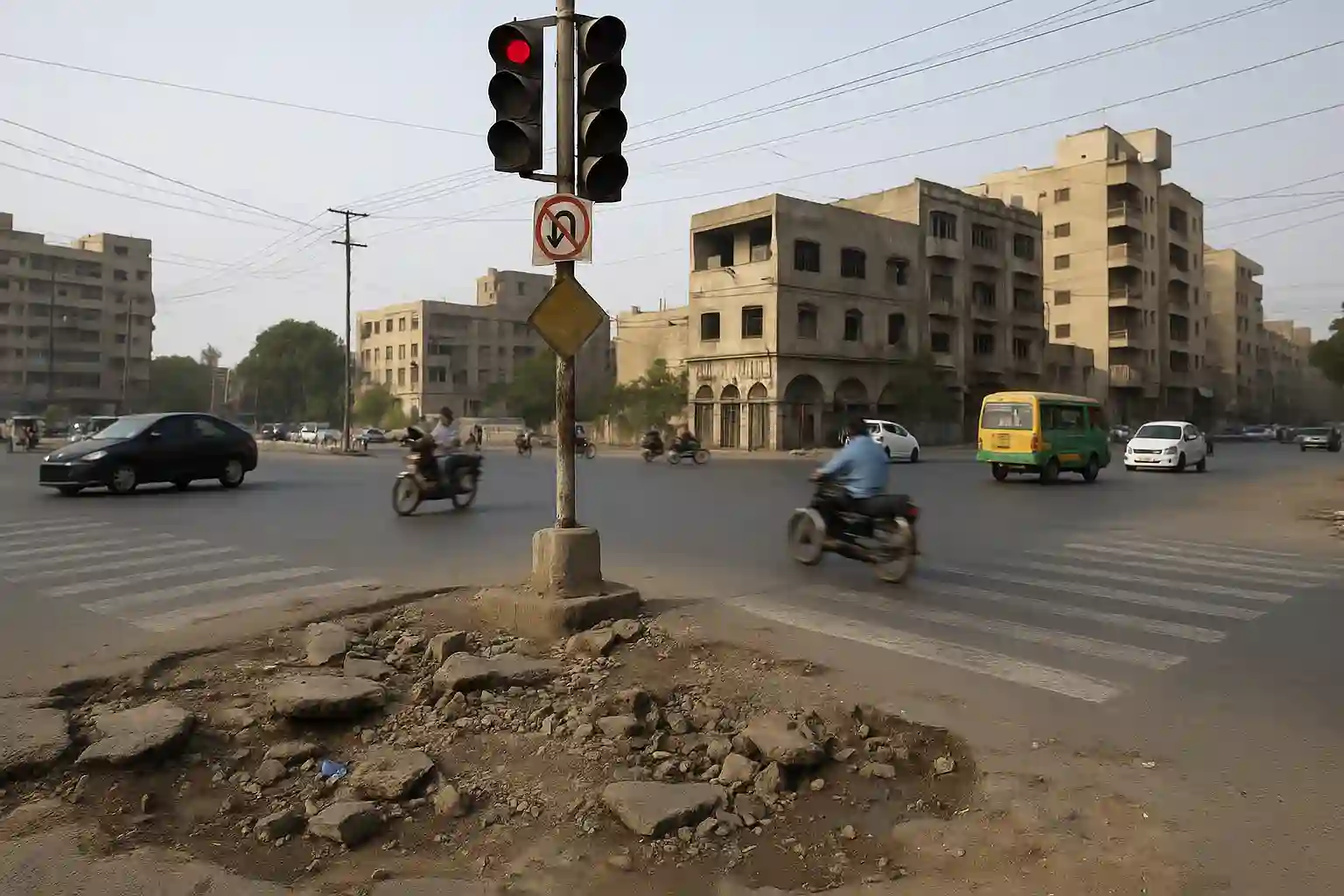
Karachi’s traffic system is once again under fire as the number of e-challans continues to rise while the city’s traffic infrastructure remains severely neglected. Despite the Sindh government’s push for strict enforcement, major coordination gaps between departments have left Karachi’s roads mismanaged, unsafe, and increasingly congested.
Officials reveal that the absence of a unified traffic engineering authority has become the biggest obstacle in fixing the city’s broken traffic network. Multiple government bodies currently share responsibility for signals, signage, and road design—resulting in confusion, delays, and little accountability.
E-Challans Up, But Roads Still Broken
Sources told Dawn that while enforcement has become stricter, the engineering side of Karachi’s traffic system is collapsing. E-challans continue to be issued at a rapid pace, yet commuters face daily chaos due to dysfunctional signals, poor lane markings, and unregulated intersections.
The Traffic Engineering Bureau (TEB) of the Karachi Development Authority (KDA), the Sindh Mass Transit Authority (SMTA), and various cantonment boards all control different parts of the traffic network. This divided structure has made citywide improvements nearly impossible.
90 Traffic Signals Nonfunctional Across Karachi
KDA officials confirmed that of the 130 traffic signals in Karachi, 90 are under TEB’s domain, while cantonment boards manage the remaining 40.
However, due to severe financial limitations, TEB is only able to maintain 50 out of its 90 signals. The remaining 40 are nonfunctional and require major repair or replacement.
This means that nearly one-third of Karachi’s traffic signals are dead, directly contributing to traffic jams, accidents, and dangerous intersections.
KDA Director General Asif Jan Siddiqui admitted that the authority is struggling to maintain even the existing infrastructure, citing the lack of a stable budget.
Check Also: Why Sindh Wheat Market Is Shifting? Shocking Price Gap Explained!
Why Karachi’s Traffic System Continues to Fail
Experts say Karachi’s traffic failures stem from three major issues:
- No single authority controls all signals, signage, and road design.
- Budget shortages prevent repairs and modernization of existing infrastructure.
- Outdated engineering practices create bottlenecks and accident-prone intersections.
The situation has worsened over time, especially as traffic volume grows and new vehicles enter the city every day.
Government Considers Karachi Traffic Management Company (KTMC)
To fix the fragmented system, the Sindh government is now considering the creation of a new body — the Karachi Traffic Management Company (KTMC).
According to officials, KTMC would centralize all traffic engineering responsibilities under one authority. The proposed agency would oversee:
- Installation and repair of traffic signals
- Road and lane markings
- Zebra crossings
- U-turns and intersection redesign
- Modern traffic engineering standards
- Safety audits across Karachi
If established, KTMC could finally bring consistency to signal standardization, traffic flow planning, and enforcement cooperation with the police.
Will KTMC Solve Karachi’s Traffic Crisis?
Experts believe a unified authority is essential, but its success will depend on:
- Adequate funding
- Transparent management
- Clear accountability
- Collaboration with police, KDA, cantonment boards, and SMTA
Without these elements, the new authority risks becoming another department with limited impact.
Check Also: Careerjobs1737 NESCOM Atomic Energy Jobs 2025 Announced – Apply Online Today
Public Reaction: E-Challan or Easy Chaos?
Citizens argue that issuing e-challans is pointless if the infrastructure itself is dysfunctional. Many complain that:
- Signals don’t work
- Road markings are missing
- Intersections are confusing
- U-turns are poorly designed
- Wrong-way driving is common
People are demanding that before increasing enforcement, the government must fix the engineering side of Karachi’s roads.