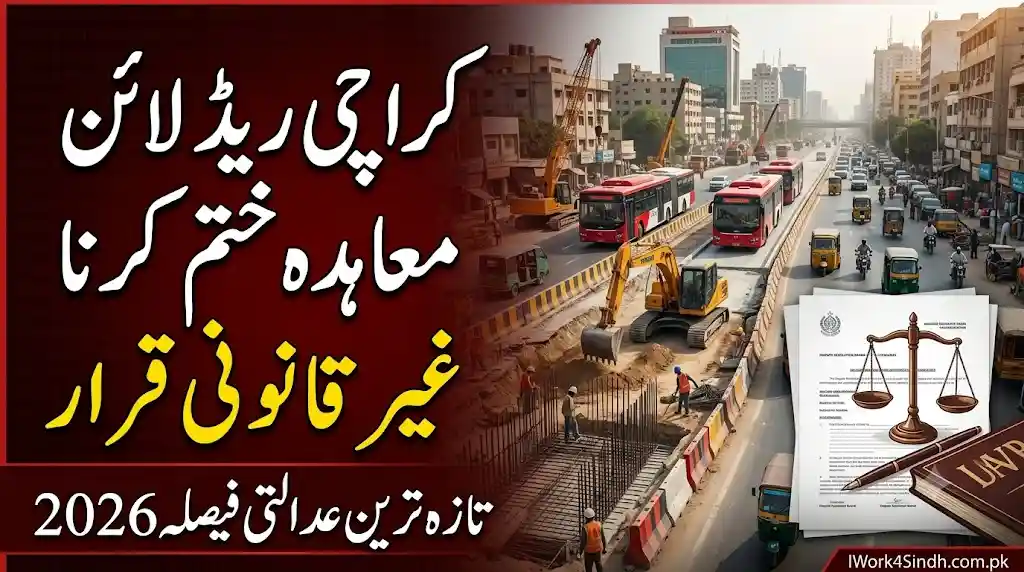
Karachi Red Line Contract Termination Declared Unlawful 2026 – Latest Court Ruling
Karachi’s Bus Rapid Transit (BRT) Red Line project is back in the headlines after a major ruling shook up its already troubled construction history. In August 2026, the Dispute Resolution Board overseeing the project declared that the Sindh government’s decision to terminate the Red Line Lot-2 contract was “unlawful, invalid, null and void.” The ruling has reopened questions about the future of one of Karachi’s most important public transport projects and has put fresh pressure on the provincial government to explain how the project will move forward.
This development matters to anyone who follows Karachi public transport news, because Lot-2 covers a large and heavily used stretch of the city. The ruling doesn’t just settle a legal argument between two parties — it directly affects when, and whether, Karachi residents will finally get a working Red Line corridor.
Karachi Red Line Contract Termination: What Happened?
The story began earlier in 2026, when the Sindh government, through the transport department and project agency TransKarachi, terminated the construction contract for Red Line Lot-2. The contract had been awarded to AM Associates (working with CR3), and its termination meant the contractor’s project office was sealed and work on the site was halted.
The termination was announced in April 2026. Soon after, the contractor moved the Sindh High Court, arguing that the termination notice was unlawful and asking for the project site to be unsealed. The Sindh High Court did not rule on the substance of the dispute itself. Instead, it directed both sides — the Sindh government and the contractor — to take the matter to the Dispute Resolution Board, as required under the terms of their construction contract.
Why Was the Red Line Lot-2 Contract Terminated?
The Sindh government’s stated reason for the Red Line contract cancellation was persistent delay and unsatisfactory progress on the project. TransKarachi said the contractor had failed to keep pace with construction timelines and raised concerns about the quality of ongoing work. These concerns were reportedly reinforced after a visiting delegation from the Asian Development Bank (ADB) — one of the project’s international financiers — flagged issues with the pace of work as well as health, safety, and environmental compliance at the site.
On the other side, AM Associates rejected this explanation. The contractor argued that the delays were not its fault, and instead blamed TransKarachi and the Sindh government for repeatedly changing station designs and failing to provide the technical drawings needed to keep construction moving.
Latest Ruling on Karachi Red Line Contract
After the Sindh High Court referred the matter to the contractually mandated dispute forum, the Dispute Resolution Board spent more than two months reviewing evidence, hearing arguments, and examining the project’s history before issuing its decision in August 2026.
The board’s conclusion was unambiguous: the Sindh government’s termination of the Red Line Lot-2 contract was declared unlawful, invalid, and null and void. This is one of the strongest possible findings a dispute board can make, effectively stating that the termination should never have happened under the terms of the contract.
Dispute Resolution Board Decision Explained
The Dispute Resolution Board, made up of three independent members, examined whether the Sindh government had valid contractual grounds to end the agreement. According to the board’s findings, the delays on Lot-2 were largely linked to repeated revisions of station designs and administrative shortcomings on the employer’s side, rather than failures by the contractor.
The board noted that out of 16 planned stations on the Lot-2 corridor, a revised design had only been delivered for one station by November 2025, while designs for the remaining stations had still not reached the contractor by the time the contract was terminated. Based on this, the board found that delayed and incomplete design provision was a major contributor to the project’s slow progress.
Importantly, the board also stated that a contract cannot simply be terminated because a project has not been finished within its original timeframe, especially when the delay stems from causes outside the contractor’s control. It went further, raising concerns about TransKarachi’s own project management capacity, questioning whether the agency had the experience needed to run a project of this scale and complexity. The board also concluded that the termination decision did not appear to have followed a genuine review of contractual alternatives before cancellation, meaning it was not treated as a measure of last resort.
Sindh Government and Contractor Positions
Sindh government’s position: Officials maintained that the termination was necessary because of ongoing delays, poor pace of work, and compliance issues flagged during ADB’s site visit. The government framed the decision as a response to what it viewed as consistent underperformance by the contractor.
Contractor’s position: AM Associates maintained throughout the dispute that the delays stemmed from the government’s own failure to finalize and deliver station designs on time, along with broader administrative issues on the client side. The contractor argued the termination notice was unlawful from the outset and reserved the right to challenge it before an appropriate forum, which it ultimately did through the Sindh High Court and then the Dispute Resolution Board.
Impact on Karachi BRT Red Line Project
The ruling represents a significant setback for the Sindh government’s handling of the Red Line project and raises fresh doubts about the project’s completion timeline. The Red Line was originally launched in 2022 with a 30-month construction schedule, targeting completion by mid-2024. That deadline has long since passed, and with this contract dispute now resolved in the contractor’s favour, further delays are likely while both sides work out how to resume construction.
Construction along the Lot-2 corridor, which runs through busy areas including University Road, had already been stalled for months due to the termination and site sealing. Commuters in these areas have continued to deal with disrupted routes, ongoing congestion, and construction material left idle at the site. With the termination now overturned, questions remain about how quickly work can restart and under what revised terms.
What Happens Next for Karachi Red Line?
With the Dispute Resolution Board’s decision in place, the immediate question is whether the Sindh government will accept the ruling or seek to challenge it further. Since the dispute board process was itself triggered by the Sindh High Court’s direction, any further disagreement could potentially return to the court system.
In practical terms, restarting Lot-2 construction will likely require the Sindh government and TransKarachi to formally resume the contract with AM Associates, unseal the project site, and finalize the outstanding station designs that the board identified as a major cause of delay. The ruling’s criticism of TransKarachi’s project management capacity also suggests that oversight and coordination on the project may need to be strengthened going forward.
Why the Red Line Project Matters for Karachi
The Red Line is one of the largest public transport investments in Karachi’s recent history, backed by multiple international financiers including the Asian Development Bank, the Asian Infrastructure Investment Bank, the French Development Agency, and the Green Climate Fund, alongside funding from the Sindh government. It is designed to provide a dedicated bus rapid transit corridor connecting key parts of the city, easing congestion and offering a faster, more reliable commuting option for thousands of daily travellers.
Given Karachi’s ongoing struggles with traffic congestion and limited organized public transport options, delays to a project of this scale carry real consequences for commuters, businesses, and the overall urban mobility plan for the city.
Key Facts About the Red Line Contract Dispute
- The dispute concerns Lot-2 of the Karachi BRT Red Line project, covering the Mosamiyat-to-Numaish corridor, including sections along University Road.
- The Sindh government terminated the Lot-2 contract in April 2026, citing delays and unsatisfactory performance.
- The contractor, AM Associates, challenged the termination in the Sindh High Court.
- The Sindh High Court directed both parties to the Dispute Resolution Board, as required under the project contract.
- In August 2026, the board declared the termination “unlawful, invalid, null and void.”
- The board found that delayed and incomplete station design delivery was a major cause of the project’s delays.
- The ruling also raised concerns about TransKarachi’s project management capacity.
- The Red Line project was originally scheduled for completion by mid-2024, but remains unfinished as of 2026.
Karachi BRT Project 2026 Conclusion
The Dispute Resolution Board’s ruling marks a turning point in the long-running Karachi Red Line saga. By declaring the Sindh government’s termination of the Lot-2 contract unlawful, invalid, and null and void, the board has placed responsibility for much of the project’s delay on design and administrative issues rather than contractor performance alone. What happens next will determine how quickly construction can resume on this critical corridor — and how soon Karachi’s commuters can expect to see meaningful progress on a public transport project the city has been waiting years to complete.