
Karachi Delhi Government School Sealed – Latest News and Update
Karachi Delhi Government School Sealed is the news dominating Karachi education news this week, as one of the city’s oldest and most respected public institutions has officially been shut down on court orders. The Delhi Government School Karachi building, located in Federal B Area’s Karimabad neighbourhood, was sealed after decades of legal wrangling finally reached their conclusion. For thousands of families who have relied on this historic school in Karachi for affordable, quality education, the closure marks the end of an era — and the beginning of a new, uncertain chapter.
This article brings you the complete Delhi Government School Karachi latest update, including the background of the dispute, the reaction from students and teachers, and what happens next.
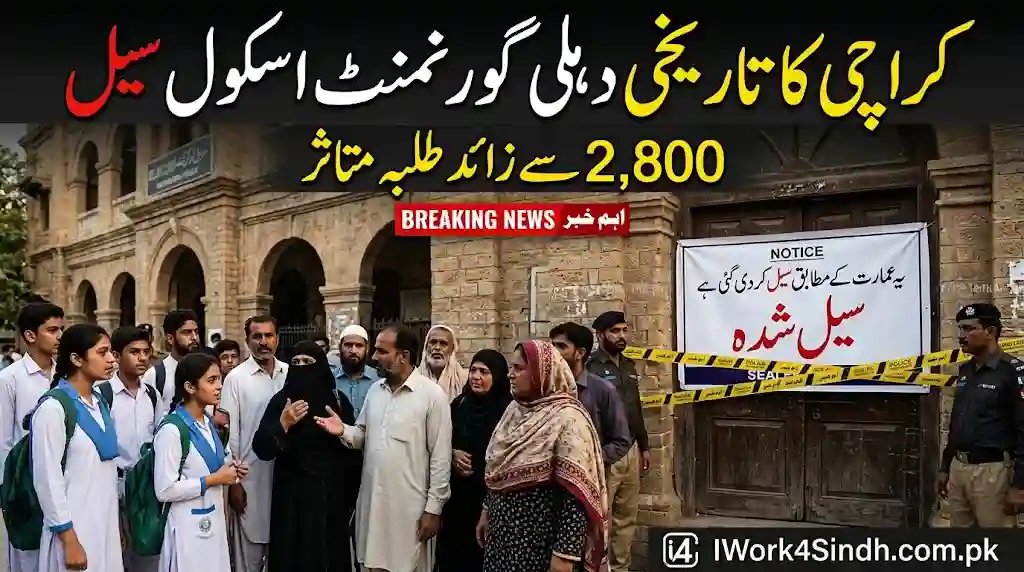
Why the Delhi Government School Was Sealed
The Delhi Government School sealed development came after a court order directed that the building be handed over to the Old Boys Association, the group recognised as the property’s legal owners. Following the sealing, the Sindh Education Department’s Directorate of Education placed an official notice outside the school premises, instructing students and teachers to contact the District Education Officer (DEO) or the Directorate for further guidance on the way forward.
Officials confirmed that the handover of the building to the Old Boys Association was carried out in compliance with the court’s directives, closing a legal chapter that had remained unresolved for nearly two decades.
The Background of the Delhi Government School Court Order
The roots of this dispute go back to the early years after Pakistan’s independence, when the building was originally associated with the Delhi Anglo-Arabic College and Schools Old Boys Association, a group of migrants who had relocated from Delhi. According to available reports, the property was later nationalised during the 1970s, placing it under government control and administration.
Under this arrangement, the Sindh Education Department was responsible for paying rent to the building’s owners. However, reports indicate that rent payments fell behind over time, prompting the Old Boys Association to pursue the matter through the courts. According to officials, the education department had continued paying rent for years afterward, with the department stating that payments were made up to a certain point before the dispute intensified — though the two sides could not reach a lasting agreement on the building’s status.
After prolonged litigation, the courts ultimately ruled in favour of de-nationalising the property and ordered that it be vacated and handed back to its recognised owners, paving the way for this week’s sealing.
A Similar Situation
This is not the first time the Delhi Government School Karachi court order has threatened the institution’s future. According to Karachi’s Director of Schools, a similar court order for handing the building over to the Old Boys Association was issued as far back as 2007. At that time, public schools in Karachi were administered under the city government (nazim) system, and the then city nazim reportedly intervened to keep the school under government control, allowing it to continue operating for nearly two more decades.
Notably, officials also recalled that in 2007, students had broken open the lock on the building themselves and re-entered the premises — a striking parallel to events reported this week, described further below.
A Historic School in Karachi’s Education Landscape
To understand why this school sealing in Karachi has generated such strong public reaction, it helps to look at the institution’s remarkable history. Delhi Government School was, for decades, considered one of the most prestigious government schools in Karachi.
Decades of Academic Excellence
During the 1980s and early 1990s, the school was widely regarded as an academic powerhouse. Its students routinely secured top positions in the citywide matriculation (SSC) board examinations, and according to reports, the institution continued to dominate board results until around 1996. In years when another public school managed to claim the top spot, Delhi School reportedly reclaimed the position the following year — a testament to its consistent academic strength.
A School of Prestige and Competitive Admissions
Admission to Delhi Government School was, for many years, considered highly competitive and even a mark of social prestige among Karachi’s elite families. Parents often sought influential recommendations simply to secure a seat for their children. The school’s teaching staff also carried a distinguished reputation, and a transfer to Delhi School was seen as an honour among senior government school teachers.
Much of this reputation is tied to the school’s celebrated former headmaster, remembered fondly as “Shamsi Sahib,” who was known for firmly rejecting influential admission recommendations, according to a former education department official who recalled his commitment to merit-based admissions.
Impact on Students, Teachers, and Parents
The Delhi Government School students affected by this closure include children enrolled across the school’s boys’ and girls’ sections, which together operate as three separate government schools within the same building complex — two girls’ schools running morning and evening shifts, and a boys’ school operating in the morning.
Reports on the exact number of affected students vary. The Director Schools Education (Secondary) told local media that total enrolment at the school stood at around 2,000 students, while at least one other report cited a higher figure of more than 2,800 students potentially affected by the closure. Given these differing figures, readers should treat the precise enrolment count as an estimate pending further official clarification, though officials agree the number runs into the thousands.
Students Protest the Karachi School Closure
News of the sealing triggered immediate reaction. Following the announcement, students, along with concerned parents and teachers, gathered at the school in protest against the sudden closure. During the demonstrations, it was reported that students entered the premises after the locks on the gates were broken. This development is noted here purely as a factual account of events as reported, without endorsing or encouraging any unlawful action; local authorities and school officials were reportedly engaging with the situation as it unfolded.
Parents and teachers have expressed concern that the sudden nature of the closure leaves students mid-way through their academic year, with little clarity on where they will continue their studies.
What Education Officials Are Saying
Officials from the Sindh Education Department have acknowledged the seriousness of the situation. The Director of Schools confirmed that the department had continued to follow the case in court over the years and had regularly paid rent to the relevant party, with payments reportedly made up to a recent date before the dispute reached its current stage.
Authorities say they are now appealing to the Revenue Department and the Commissioner of Karachi to expedite matters related to the potential purchase of the building, in an effort to find a long-term solution. In the meantime, the department says it is actively working on relocation plans, aiming to shift the affected students to nearby government schools in Karachi. However, officials have also noted that many students and parents remain reluctant to leave the institution they consider their academic home.
Why This Karachi School Closure Matters
The Delhi Government School Karachi sealing is more than just the closure of one building — it highlights a broader, recurring problem in the management of Karachi’s public education infrastructure. Similar disputes involving building leases, unpaid rent, and unresolved ownership issues have reportedly affected other well-known institutions in the city as well.
For low- and middle-income families who depend on government schools in Karachi for affordable education, disruptions like this can have an outsized impact. Education stakeholders have pointed out that administrative delays in resolving property and lease matters ultimately place the burden on students, who have no role in the underlying disputes.
What Happens Next
Looking ahead, several developments are expected to shape the future of the institution:
- The Sindh Education Department is pursuing legal remedies, including efforts to expedite a possible purchase of the building through the Commissioner and Revenue Department.
- Officials are working on a relocation plan to accommodate displaced students in nearby government schools.
- The Old Boys Association, now recognised as the legal custodian of the building, has indicated an intention to eventually improve the quality of education offered at the site, should it resume operations under their management.
- Further updates are expected as both sides continue to navigate the legal and administrative process.
Latest Update on Karachi Delhi Government School Conclusion
The Karachi Delhi Government School sealed news has struck an emotional chord across the city, reviving memories of an institution once synonymous with academic excellence and civic pride. While the court-ordered sealing formally closes this chapter of the school’s decades-long ownership dispute, the human impact — on students uncertain about their next classroom, on teachers facing reassignment, and on a community losing a piece of its history — remains very much unresolved.
As the Sindh Education Department works toward relocation plans and pursues further legal avenues, the coming weeks are likely to determine what becomes of one of Karachi’s most storied public schools. For now, this Delhi Government School Karachi latest update serves as a reminder of how deeply intertwined educational institutions are with the communities and generations they serve.