
Why Pakistan Needs More Provinces? Benefits, Challenges & Future Outlook
Pakistan is currently divided into four provinces — Punjab, Sindh, Khyber Pakhtunkhwa, and Balochistan — along with Gilgit-Baltistan, Azad Jammu and Kashmir, and the federal capital territory of Islamabad. For decades, a recurring debate in Pakistani politics has centered on administrative reforms and the creation of new provinces, most notably South Punjab (or a Seraiki province), a Hazara province, and a Bahawalpur province. This debate raises an important question: does Pakistan need more provinces, and if so, what would it take to make that happen?
This article explores the benefits, challenges, and future outlook of creating new provinces in Pakistan, examining the topic from multiple angles rather than advocating for a single position.
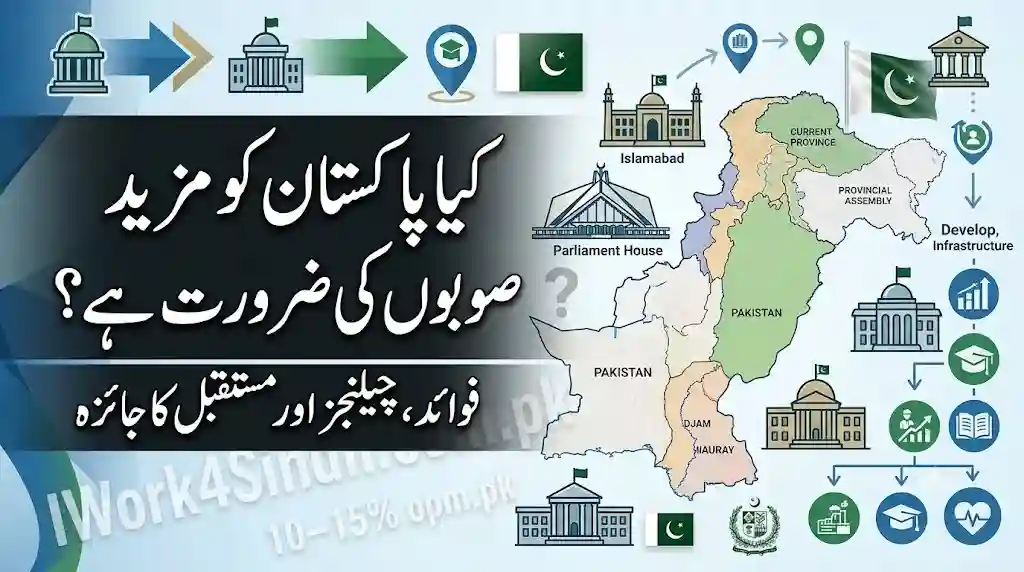
The Case for More Provinces
1. Better Governance and Administrative Efficiency
One of the strongest arguments in favor of new provinces is administrative efficiency. Punjab, for instance, is home to over 110 million people — more than many countries in the world — yet it is governed as a single administrative unit. Proponents argue that smaller provinces would bring decentralized governance closer to the people, reduce bureaucratic bottlenecks, and allow local issues to be addressed more quickly by officials who understand regional realities.
2. Addressing Regional Grievances and Deprivation
Movements such as the demand for a South Punjab province (sometimes called the Seraiki province) and a Hazara province in Khyber Pakhtunkhwa stem from long-standing complaints about economic neglect and underdevelopment. Residents of these regions often argue that provincial capitals like Lahore and Peshawar absorb the bulk of development funds, while their own districts lag behind in education, healthcare, and infrastructure. Creating new provinces, advocates say, could ensure a fairer distribution of resources under Pakistan’s National Finance Commission (NFC) Award, since provincial status typically comes with a direct share of federal funds.
3. Preserving Local Identity and Culture
Many of the demands for new provinces are also tied to linguistic and cultural identity. The Seraiki-speaking population of South Punjab, for example, has long argued that its distinct language and culture are overshadowed within a Punjab-centric administrative and political structure. A separate province, in this view, would give local communities greater control over education, culture, and local policy — helping preserve identity that might otherwise be diluted.
4. Political Representation
Smaller provinces would also mean more Senate seats and greater representation in federal institutions, since Pakistan’s Senate allocates equal seats to each province regardless of population. This could give underrepresented regions a stronger voice in national decision-making, an argument frequently raised by pro-province movements in South Punjab and Karachi-based Muhajir groups advocating for a separate Sindh administrative unit.
The Challenges of Creating New Provinces
While the arguments in favor are compelling, the path to creating new provinces is far from simple.
1. Constitutional Hurdles
Under Article 239 of the Constitution of Pakistan, creating a new province requires approval by a two-thirds majority in both houses of Parliament, as well as consent from the provincial assembly of the province being divided (via a resolution passed by at least a two-thirds majority). Given Pakistan’s fragmented and often adversarial party politics, mustering this level of consensus is extremely difficult.
2. Political Resistance
Major political parties, especially those with strong bases in existing provinces like Punjab, have historically been reluctant to support division, fearing a loss of political and electoral influence. The Pakistan Muslim League-Nawaz (PML-N), for instance, draws much of its power from a united Punjab, making any serious move toward splitting the province politically risky for the party in power.
3. Financial and Administrative Costs
Setting up a new province requires building an entirely new administrative apparatus — a provincial assembly, secretariat, high court bench, police structure, and civil service — all of which come with significant financial costs. Critics argue that in a country already grappling with a fragile economy and heavy debt burden, diverting resources to create new bureaucratic structures may not be the most efficient use of public funds.
4. Risk of Fragmentation and Ethnic Tensions
Some analysts warn that redrawing provincial boundaries could open the door to further demands for division, potentially along ethnic or linguistic lines, which could increase regional tensions rather than resolve them. Balochistan and Sindh, for example, have their own sensitivities around demographic changes and resource control, and any restructuring elsewhere in the country could reignite similar debates in these provinces.
Future Outlook
The debate over new provinces is unlikely to disappear soon. In recent years, discussions about a South Punjab province have gained renewed traction, with some political parties including it in their manifestos, and the Punjab Assembly even took symbolic steps such as creating a South Punjab Secretariat to devolve some administrative functions without full provincial status. This kind of administrative devolution short of full province status may represent a realistic middle path — offering some of the benefits of decentralization without the constitutional and political battles of a full division.
Looking ahead, the future of Pakistan’s provincial map will likely depend on:
- Political will among major parties to prioritize national interest over regional power bases
- Public pressure from underrepresented regions demanding better governance and resource allocation
- Economic feasibility studies assessing whether new provinces would genuinely improve service delivery
- Constitutional consensus-building, given the high threshold required for any change
Future of Pakistan Provinces Conclusion
The question of whether Pakistan needs more provinces touches on deep issues of governance, identity, resource distribution, and political power. Supporters see new provinces as a path to better administration, fairer development, and stronger representation for marginalized regions. Critics warn of the financial burden, political complexity, and risk of deepening ethnic and regional divides. As Pakistan continues to grapple with governance challenges, the debate over administrative restructuring and new provinces will likely remain a live issue in national politics — one that requires careful, balanced deliberation rather than quick decisions.